Clear The Air Energy Blog Rotating Header Image

Fuels

Big oil, big tobacco, big lies

http://www.irishexaminer.com/viewpoints/analysis/big-oil-big-tobacco-big-lies-358320.html

Kelle Louaillier and Bill McKibben

Just as big tobacco deliberately misled the public on the cancer-causing effects of smoking, big oil attacked scientists who warned of the impending climate disaster and their attempts now to help ‘solve’ the problem should be shunned by governments, write Kelle Louaillier and Bill McKibben

OVER the last few years, a growing number of people have been taking a hard look at what is happening to our planet — historic rising sea levels, massive floods — and acknowledging, finally, that human activity is propelling rapid climate change. But guess what? Exxon (now ExxonMobil) had an inkling of this as early as 1978.

By the early 1980s, Exxon scientists had much more than an inkling. They not only understood the science behind climate change, but also recognized the company’s own outsize role in driving the phenomenon.

Recognizing the potential effects as “catastrophic” for a significant portion of the population, they urged Exxon’s top executives to act. Instead, the executives buried the truth.

There may be a silver lining to this infuriating story: The recent investigation that exposed Exxon’s deceit could end up catalysing the action needed to address the looming climate crisis. After all, similar revelations about the tobacco industry — what the major cigarette companies knew and when they knew it — transformed the public-health landscape.

In 1996, a series of lawsuits forced tobacco companies to release millions of internal documents, which confirmed what public-health advocates and policymakers had long suspected: As early as the 1950s, the industry knew that nicotine was addictive and that cigarettes caused cancer.

But, to protect its own interests, big tobacco deliberately misled the public, doing everything possible to cast doubt on scientific findings that it knew to be accurate. Such tactics enabled the industry to delay, for more than 50 years, regulation that could have saved millions of lives annually.

After the revelations, however, it was clear that the tobacco industry was a malevolent force that did not belong in the policymaking process. With big tobacco out of the picture, and armed with evidence of the real effects of tobacco consumption, health advocates were finally able to compel their governments to act.

In 2003, world leaders agreed to the Framework Convention on Tobacco Control (FCTC), negotiated under the auspices of the World Health Organisation. Today, the treaty covers 90% of the world’s population and has contributed to a significant decline in sales for global tobacco corporations. Over time, it will save hundreds of millions of lives (and save governments’ health budgets huge sums).

Big oil, it is now clear, has been following big tobacco’s playbook. In 1997, almost two decades after it began studying climate change, it quashed its research, claiming that climate science was “far from clear” and thus it did not “support mandated cuts in energy use.”

Beyond suppressing its own findings, ExxonMobil (and its peers) funded and promoted junk science and attacked scientists who warned of the impending climate disaster. The fossil-fuel companies’ approach was so effective that the media are only now beginning to recognise the leading role the industry played in creating — almost out of whole cloth —the so-called climate debate.

But perhaps big oil’s biggest success was diminishing the political will to implement appropriate regulation. Even after the international community adopted the UN Framework Convention on Climate Change (UNFCCC) in 1992, the fossil-fuel industry managed to block meaningful progress — to the point that, if serious action is not taken soon, the entire process could unravel.

In Europe, Royal Dutch Shell’s lobbying so diluted the EU’s efforts that there are now no binding targets for renewables or energy efficiency for individual countries. The company even sent a letter to the European Commission’s president claiming that “gas is good for Europe.” Shell and other oil companies are now promising to work as “advisers” to national governments on how to deal with climate change.

Just as the tobacco files drove the tobacco industry out of policymaking processes, the Exxon investigation should compel world leaders to eliminate the fossil-fuel industry from efforts to solve the climate crisis. After all, no policy can succeed if those who shape it are betting on its failure.

The turning point for tobacco-related public-health policy came when the industry’s depravity became indisputable. Now, that moment has come for the climate movement.

We cannot simply hope that the fossil-fuel industry will change its ways. As an alliance of human-rights groups, environmental activists, and corporate-accountability advocates already is demanding, we must kick the industry out of the policymaking process altogether.

Exxon’s scientists were right: The effects of climate change on many communities are catastrophic. With so many lives at stake — and such clear evidence of the threat big oil, like big tobacco before it, should be treated for what it is: big trouble.

Kelle Louaillier is president of Corporate Accountability International. Bill McKibben, a scholar in environmental sciences at Middlebury College and member of the American Academy of Arts and Sciences, is co-founder of 350.org.

UK guarantees £2bn nuclear plant deal as China investment announced

http://www.bbc.com/news/uk-england-somerset-34306997

Chancellor George Osborne has announced that the UK will guarantee a £2bn deal under which China will invest in the Hinkley Point nuclear power station.

Mr Osborne, who is in China, said the deal would pave the way for a final investment decision on the delayed project by French energy company EDF.

He said it would also enable greater collaboration between Britain and China on the construction of nuclear plants.

Reports suggest one such reactor could be built at Bradwell-on-Sea in Essex.

Energy Secretary Amber Rudd told the Financial Times she wanted Beijing to take the lead in developing new nuclear plants in Britain.

She said China was expected to lead the construction of a Beijing-designed nuclear station at the Essex site.

Hinkley in numbers

£25bn Cost of new Hinkley plant
£5.2bn Cost overrun of EDF’s Flamenville plant in France
£89.5 Price per MW/hr guaranteed to EDF by government
£44 Current price per MW/hr of wholesale electricity in UK

World Nuclear News, Ofgem

EDF welcomed news of the government guarantee, but did not say if it put the project back on track.

Earlier this month, EDF admitted the Hinkley project in Somerset, which was intended to allow the plant to generate power by 2023, would be delayed.

In February, the firm announced that it had pushed back its decision on whether to invest in the plant.

It cannot afford the estimated £24.5bn cost of the plant on its own, so has been looking for financial partners to invest, particularly in China. This has proved difficult, which is why the government has had to step in to guarantee part of the cost.

The new power station would be Britain’s first new nuclear plant for 20 years and is expected to provide power for about 60 years.

Speaking in Beijing at a joint news conference with China’s Vice-Premier Ma Kai, Mr Osborne said: “We want the UK to be China’s best partner in the West. [This guarantee] paves the way for Chinese investment in UK nuclear [to help provide] secure, reliable, low carbon electricity for decades to come.”

He also announced a new £50m joint research centre for nuclear energy.

The difficult economics of nuclear power

By Richard Anderson, BBC business reporter

Nuclear power plants are mind-bogglingly expensive to build.

In China, relatively cheap labour means they typically cost between £6bn-£10bn, with the state-controlled economy providing the necessary regulatory and financial support.

But in the free markets of the West, they cost many times more. No private company can afford this amount of money, particularly given it will be almost 10 years before the plant is operational and can begin generating a cash return.

This is why governments have to get involved, providing subsidies of one sort or another.

Hence George Osborne’s announcement. The government has already guaranteed EDF a price – many would argue a very high price – for the electricity it generates at Hinkley, and now it is enticing the Chinese with investment guarantees.

Nuclear power: Energy for the future or relic of the past?

Q&A: Nuclear strike price

Mr Osborne said Chinese companies would receive a substantial stake in the project, with the UK government acting as guarantor for the investment.

The guarantee will be provided by the government’s Infrastructure UK Scheme, which provides finance for projects that have had difficulties raising money from private investors.

Ms Rudd told the BBC that nuclear power played an important part in Britain’s energy security.

“We want low-carbon electricity and if we’re going to hit our ambitious [emissions reduction] targets then we have to have nuclear,” she added.

Analysis

By Robert Peston, BBC economics editor

What is most striking about George Osborne’s Chinese tour is he is doubling his political and economic bet on the world’s number two economy at a time when that economy is looking its most fragile for 30 years.

Today’s manifestation of the China bet is confirmation of a long-trailed loan guarantee – initially worth £2bn but likely to rise substantially – to bind in Chinese and French nuclear giants to their promised massive £24.5bn investment in the Hinkley Point C new nuclear plant.

This is certainly long-term strategic planning for more power security by Osborne and the government (well they would say). With oil fluctuating at between $40 and $50 a barrel, Hinkley’s prospective electricity looks scarily expensive.

China’s huge economic changes

The government has said Hinkley will provide up to 7% of Britain’s electricity needs from 2023.

EDF, which will continue to control the venture, has agreed to provide electricity from Hinkley at a guaranteed minimum price of £89.50 per MW/hr for 35 years. Renewable energy technologies have been given a guaranteed price for 15 years._85687811_energy_strike_prices_v3

Ms Rudd rejected criticisms that this was too expensive, saying nuclear power was “reasonably priced” compared with other low carbon sources of power.Vincent de Rivaz, chief executive of EDF Energy, said the chancellor’s announcement was “further progress towards a final investment decision” on the plant.

He said: “The chancellor’s approval of the infrastructure guarantee is a clear sign of the government’s commitment to Hinkley Point C. The government’s determination to bring about a renewal of infrastructure and to attract inward investment to the UK are demonstrated by this good news.

‘Rip-off’

But Greenpeace’s chief scientist Dr Doug Parr described the £2bn guarantee from George Osborne as “signing up the country for the ultimate rip-off deal”.

He added: “Instead of locking two generations of UK consumers into paying billions to foreign state-owned firms, Osborne should invest in the flexible, smart, and truly clean energy system that can power a 21st Century Britain without leaving a pile of radioactive waste as legacy.”

Other critics have raised concerns about the design of the new reactor, which will use new so-called EPR technology. Similar reactors being built in France and Finland are both late and way over budget.

The union Unite welcomed the government’s commitment to non-carbon nuclear power, but it said it should not allow China to build a plant in the UK, describing its nuclear technology as “unproven”.

East Delhi Commissions Hydropower Plant Powered By Sewage Effluent

http://cleantechnica.com/2015/09/14/east-delhi-commissions-hydropower-plant-powered-by-sewage-effluent/

Delhi is getting its first hydropower plant, but it’s not harvesting the energy of running water in the traditional hydroelectric model, as this new system uses falling water from a treated sewage effluent pipe to spin its turbine.

Recapturing some of the energy in flowing water that is generated by existing processes, such as municipal water supplies, is one non-traditional step for hydropower, and cities such as Portland have begun experimenting with this sort of ‘smart water pipe infrastructure.‘

The new hydropower plant, in East Delhi, India, is built onto the Delhi Jal Board’s 9 MGD sewage treatment plant at Chilla, and is said to be the first of its kind, not only because it’s being powered by effluent water, but also because it’s the first hydropower plant in the city. According to the Delhi Jal Board (DJB), this pilot project was set up “free of cost,” and the estimated annual 20,000 kWh of electricity produced by the hydropower installation will be used directly at the sewage treatment plant.

“The use of fossil fuels leads to the generation of carbon dioxide which in turn leads to Green House Effect and Global Warming. However no fossil fuel is being used in the generation of the power through Hydropower at Chilla, therefore this technology is termed as “pollution free technology.”” – Delhi Jal Board

The treated effluent water falls from a height of 4.8 meters at the sewage treatment plant, which is sufficient to spin the turbine and generate clean electricity, and this ‘Green Power Generation’ energy technology will help to reduce both air pollution and electricity costs. No additional specs, other than the estimated 20,000 kWh of electricity annually, for the installation were available. According to DJB, the Board is also looking to replicate this hydropower setup at its other installations in the future.

Could Fuel Cells Solve the Emissions Problem for Coal Plants?

http://www.greentechmedia.com/articles/read/Could-Fuel-Cells-Solve-the-Emissions-Problem-for-Coal-Plants

With a little extra engineering work, some researchers believe fuel cells could become one of the most affordable ways for coal plants to keep their doors open as pollution regulations tighten.

The Department of Energy selected FuelCell Energy Inc. (FCE) last week as one of eight funding recipients to pilot low-cost carbon dioxide capture and compression technologies. The $23.7 million project (with $15 million coming from the DOE and $8.7 million from FCE) will see a 2-megawatt fuel cell deployed at a coal-fired power plant designed to capture about 60 tons of CO2 per day, while simultaneously producing about 40,000 kilowatt-hours of electricity per day.

This first-of-its-kind application is a modification to FCE’s existing Direct FuelCell technology, which the company says has already generated more than 4 billion kilowatt-hours of electricity. Researchers have been exploring the use of fuel cells for carbon capture since the early 1990s, but only recently has the technology declined enough in cost to be seriously considered as a solution.

Carbon capture only works with a molten carbonate fuel cell, a chemistry that relies on CO2 to operate. Flue gas from a coal plant contains 5 percent to 15 percent CO2, with the remainder made up largely of nitrogen, as well as other gases. In FCE’s application, the flue gas is routed into the fuel cell at one electrode, where the cell selectively takes up the CO2 and releases it in a concentrated stream at the other electrode. During this process, approximately 70 percent of the smog-producing nitrogen oxide is destroyed.

Once the CO2 is captured, it’s cooled and compressed utilizing standard refrigeration equipment. The purified carbon can then be sequestered or used for enhanced oil recovery.

FCE_carbon_capture_diagram_580_301

Today’s commercially available carbon-capture technology has proven to be extremely expensive and energy-intensive, nearly doubling the cost of electricity from a coal-fired power plant. FCE’s technology also increases the cost of electricity from coal-fired power plants, but the DOE believes that increase could be one-third or less.

“At an estimated cost of $40 per metric ton of carbon dioxide, these second generation technologies are showing they could potentially achieve a 30 percent increase in the cost of electricity, which is a significant drop compared to today’s commercially available technologies,” said José Figueroa, senior carbon capture project manager at the DOE, in an interview.

“The challenge of emissions reduction has always been to find a proven technology that’s affordable, and that’s reasonable to deploy, as opposed to spending billions,” said Arthur Bottone, CEO of FCE. “We’ve met that challenge with our solution.”

As states act to meet their compliance obligations under the EPA’s Clean Power Plan, several stakeholders will seek new technologies to clean up their coal plants. FCE has only tested its carbon-capture technology in the lab to date, but the application is already the attracting interest from the power industry and legislators in states with a high reliance on coal, said Bottone.

Questions about efficiency, scale, climate impact and cost

FCE is currently evaluating multiple sites for the DOE-supported pilot with interested utility and independent power producers, and it expects to announce the site selection this fall.

One of the selection criteria is that there needs to be a nearby supply of natural gas to power the fuel cell. Molten carbonate fuel cells take in CO2, but still need a fuel source to operate.

The chiller used to condense CO2 also needs a power source. To meet that demand, the system is outfitted with a 2.8-megawatt fuel cell, which the chiller brings down to around 2 megawatts of actual power output.

Even with these extra steps, Bottone said the fuel cell application is much more efficient than other carbon-capture technologies. Rather than drain productivity at the power plant, FCE’s technology generates additional power — and revenue — in exchange for the energy it consumes.

“This is a power generation device that concentrates CO2 at the same time. It’s a completely different thought process, versus a device that’s doing nothing but capturing CO2,” he said. “We’re multitasking on the same asset as compared to a different way of doing it, which would only be a cost and not necessarily a benefit.”

This dual use makes the project easily financeable by private capital, because the electricity generated by the fuel cell creates a reliable revenue stream, Bottone added. Selling the purified CO2 for use in other applications like enhanced oil recovery would create additional revenue, although FCE didn’t factor those sales into its financial modeling.

Another benefit is that the technology is modular, so it can be scaled up incrementally as funding becomes available.

FCE sees the DOE-supported pilot as the first phase of a much larger project. In the second phase, once the application engineering is established, FCE will seek private capital to install 11 additional fuel-cell power plants. This 25-megawatt system is expected to capture a total of 700 tons of carbon dioxide per day, while generating about 648,000 kilowatt-hours of electricity per day.

At a 500-megawatt coal plant, 25 megawatts of fuel cells would reduce emissions by between 5 percent and 6 percent, said Bottone. Under the Clean Power Plan, emissions have to fall by roughly 3 percent over a 10-year period. So by installing FCE’s technology in phases, a coal-plant operator could meet the 32 percent overall emissions reduction target in a few years, while adding about 100 megawatts of power generation to its site.

“On paper, it’s a massive market opportunity,” said Bottone. “The question is how fast we can go.”

“We think that given the significant assurance of the technology we’ve developed for other businesses, we can go pretty quick, not to mention the fact that some of these utility customers and others are already our customers,” he added. “So the business model, and the confidence in us, frankly, is already there.”

But several questions remain. For one thing, while the system captures CO2 from the natural gas fed into the fuel cell, as well as from the coal plant itself, there are still concerns about the net climate benefit because of the emissions associated with natural gas production.

There are similar concerns with enhanced oil recovery. Pumping CO2 underground could help unlock new oil resources, and the CO2 could then be sequestered underground once the reservoir is depleted. But the net benefit is unclear, since the carbon sequestration would be offset by the continued use of oil. Plus, there’s the added complexity of getting the CO2 to the oil well to begin with.

Another issue is that flue gas from a coal plant contains pollutants, such as sulfur and chlorine, that could degrade the fuel-cell stack over time. How much FCE’s application ultimately costs will depend on how much the coal plant exhaust has to be cleaned up before it enters the cell.

“A coal-fired power plant has a lot of environmental control systems to meet environmental regulations, so those emissions are very low. But fuel cells are still sensitive to many contaminants, and so the flue gas would have to go through a polishing step to get it to even lower contaminant levels before getting to the fuel cell,” said Figueroa.

Lab tests to date show that the fuel cell sees little degradation using a simulated polished gas, but more testing is needed to see how the fuel cell performs in real world conditions.

“Understand this technology is still at a small scale,” said Figueroa. “Conceptual cost estimates, versus what it will look like at a 500-megawatt scale, with all of the flue gas that needs to be processed at that level, can differ.”

“There’s a lot that can still happen as you scale up and that’s why they’re performing more research, and that takes time,” he said.

Tobacco-fueled planes set for SA take-off

http://citizen.co.za/665787/tobacco-fueled-planes-set-for-sa-take-off/

A project involving the use of “mutagenised tobacco” for aviation fuel, supported by South African Airways, Boeing and SkyNRG this week got the thumbs up from the leading global sustainability authority.

Project Solaris has been recognised by the Roundtable on Sustainable Biomaterials (RSB), which has been identified by the World Wildlife Fund and other leading international NGOs as the “strongest sustainability guarantee on the market”.

Member organisations of RSB, an independent, global multistakeholder coalition working to promote the sustainability of biomaterials, include Boeing, Airbus and the international Air Transport Association.

Maarten van Dijk, SkyNRG’s CEO, said RSB’s certification of the Solaris project is an important milestone for the company and for the aviation industry in general.

Italian research and development enterprise Sunchem Holding owns the patent for “energy tobacco”, under which Solaris is the first seed to have been developed. The patent has been granted in 110 countries.

Sunchem Holding chief executive officer Sergio Tommasini told ANA the company was also exploring options for production in Malawi and Zimbabwe. The project has the potential to leverage the knowledge and experience of established traditional tobacco farmers, although it is not necessary to have the same climate conditions because Solaris can be cultivated under various conditions, said Tommasini.

Nonetheless, a project like this depends on a lot more than the weather, including trustworthy partners with imagination, which the company has found in South Africa.

Tommasini told ANA that, in South Africa, Sunchem had “found very solid partners, and in general it is the country that more than others (Brazil, Bulgaria, North Carolina) has embraced our vision and grasped its potential, considering especially the social impact that growing energetic tobacco could generate if applied on a large scale”.

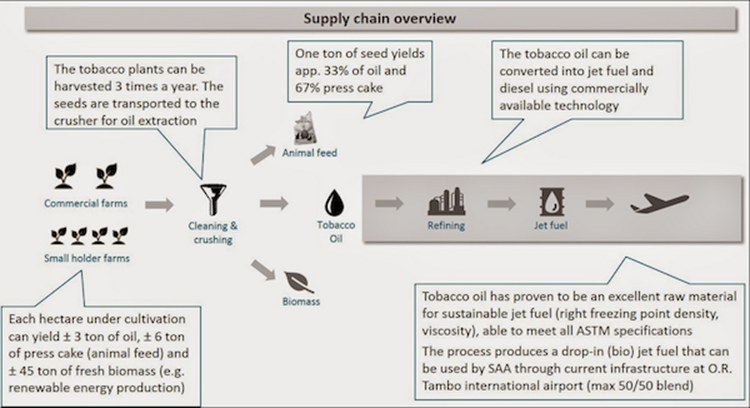
The Solaris tobacco plant is free of nicotine and GMOs and maximises the production of flowers and seeds at the expense of leaves. The seed is about 40% oil and subjected to mechanical pressure about 34% of the seed oil can be extracted. This is more than double the yield from rapeseed, soy or sunflower. What is left, being free from nicotine, can be used in fodder for animals.

The project, which uses a mix of commercial farmers and smallholders, has brought economic and rural development to the Limpopo province, but questions will be asked about using arable land to produce fuel for aeroplanes.

“Developing a biofuel crop in South Africa’s ‘breadbasket’ province has of course drawn us into the centre of the food versus fuel debate,” said Sunchem South Africa’s managing director Joost van Lier.

“Having to undergo a systematic process of evaluating the social and environmental ramifications of this development, as prescribed by the RSB, has allowed us to feel confident in promoting Solaris, not only as a financially viable crop for farmers in the region, but also one that will not affect food security or lead to environmental degradation.”

RSB executive director Rolf Hogan said: “Project Solaris has demonstrated that it can deliver sustainability on the ground in line with the RSBs global standard.”

“This is the result of a serious commitment to working with local stakeholders, rural development and reducing greenhouse gases while safeguarding the Limpopo’s unique natural environment.”

Boeing is a premium sponsor and promoter of the Solaris technology worldwide. The company’s managing director for Africa, J. Miguel Santos, said: “We applaud South African Airways and the South African government for ensuring the sustainability of their emerging aviation biofuel supply chain as it is being developed. This milestone marks a very significant step forward in ensuring positive economic, social and environmental outcomes for aviation and the planet.”

SAA said it was a proud member of the RSB. “SAA is a proud member of the RSB and subscribes to the environmental and social sustainability principles enshrined in the RSB standard. This certification ensures that future fuels contribute to reductions in CO₂ and are environmentally sustainable and contribute social and economic benefits to our rural economy where it is needed most,” the group’s environmental specialist Ian Cruickshank said.

Tobacco Aviation Biofuel Ready For Takeoff, After 25 Years Of R&D

https://cleantechnica.com/2015/09/02/tobacco-aviation-biofuel-ready-takeoff-25-years-rd/

It’s been a long time coming, but the dream of tobacco-fueled flight is inching closer to reality. Research into a commercially viable strain of “energy tobacco” dates back to 1990’s-era biofuel labwork, which has finally developed into a venture called Project Solaris. The project launched in South Africa last year and just yesterday it garnered the green light from RSB, the Roundtable on Sustainable Biomaterials.

RSB certification is essential to the long term prospects of Project Solaris, which is located in the “breadbasket” province of Limpopo. It remains to be seen if biofuel crops can be grown at scale in the region without affecting food security, but Project Solaris brought RSB on board from the beginning, which should help its chances to prove its overall benefit to local farmers.

unnamed


Project Solaris And Aviation Biofuel

CleanTechnica caught up with Project Solaris a little over one year ago, when the new tobacco biofuel venture launched with the backing of Boeing, South African Airways, and sustainable aviation biofuel marketer SkyNRG.

Project Solaris leverages a proprietary strain — non-GMO, by the way — of “energy tobacco” called Solaris, developed by the Italian company Sunchem. The strain was developed to push the bulk of the plant’s oils into seed production rather than leaves.

This handy timeline from Sunchem illustrates the 25-year progress of Solaris from the lab to a commercial prospect:

image002

On Boeing’s part, Project Solaris is part of the company’s broader interest in halophytes for aviation biofuel (halophyte is fancyspeak for salt tolerant, desert-loving plants). Boeing is far from alone in that regard. Halophytes are attractive as a biofuel source not only from a sustainability angle, but from their potential for out-performing fossil fuels, particularly petroleum derived from tar sands.

Sustainable Biofuel, From Tobacco, In South Africa

For those of you in the US who are used to thinking of the southern states as tobacco central, guess again. Domestic tobacco production peaked long ago, and now South Africa is a major producer. If the global scourge of cigarette-derived cancer is to be quelled, then South Africa will lose a major cash crop. The Solaris Project provides an opportunity to replace it with another economic and rural development opportunity.

Limpopo is already one of the major tobacco-producing provinces in South Africa, so if the aim is to replace one strain of tobacco for smoking with another for flying, growing Solaris would not necessarily carve out acreage that could be used for food crops.

That’s where the aforementioned Roundtable on Sustainable Biomaterials comes in. Our sister site Gas2.org also took note of Switzerland-based RSB’s involvement last year, when Boeing stated that the aim was to grow Solaris “without harming food supplies, fresh water or land use.

In its announcement for Project Solaris’s certification, RSB particularly noted that the Solaris strain is nicotine-free as well as non-GMO, and that Project Solaris is expected to benefit the local economy as well as jumpstart a sustainable supply chain for aviation biofuel.

Sunchem South Africa Managing Director Joost van Lier also echoed the goal of developing an aviation biofuel supply chain that benefits local economies:

Developing a biofuel crop in South Africa’s ‘breadbasket’ province has of course drawn us into the centre of the food vs fuel debate. Having to undergo a systematic process of evaluating the social and environmental ramifications of this development as prescribed by the RSB has allowed us to feel confident in promoting Solaris, not only as a financially viable crop for farmers in the region, but also one that will not affect food security or lead to environmental degradation.

As we said, that all remains to be seen once Project Solaris cranks up to speed, but so far so good. South African Airways is already lined up to use the product, and that’s just the tip of the energy tobacco iceberg.

In addition to aviation biofuel, Sunchem notes that oil from its patented “Solaris Seed Tobacco” plant has a number of other iterations, for example biodiesel for electricity generation and marine use.

After the oil is extracted, leftover biomass from Solaris could also be used for biogas generation, and it could also have application as a paper pulp feedstock. Being nicotine-free and non-GMO, Solaris biomass also has potential for use in animal feed.

For those of you keeping score at home, South African Airways (SAA) has the goal of being “the most environmentally sustainable airline group in the world,” and it committed to a sustainable aviation biofuel supply chain with Boeing back in October 2013, leading to the launch of Project Solaris.

When Project Solaris celebrated the harvest of its first crop earlier this year, Boeing noted that a test flight by SAA will follow the first seed-to-fuel conversion, and it looks like both companies are optimistic about the prospects.

SAA is planning to rely on Solaris biofuel for half of its jet fuel supply at Johannesburg’s international airport by 2023, which comes out more than 100 million gallons.


CSIRO’s Tobacco oil project: The Digest’s 2015 8-Slide Guide

Download (PDF, 1.82MB)

GE Hitachi’s ESBWR Nuclear Reactor Gains Some Industry Support

http://www.powermag.com/ge-hitachis-esbwr-nuclear-reactor-gains-some-industry-support/

GE Hitachi Nuclear Energy (GEH) and DTE Energy announced plans to explore advancing the detailed design of the Economic Simplified Boiling Water Reactor (ESBWR).

According to GEH, the ESBWR is the world’s safest approved nuclear reactor design based on core damage frequency. The reactor has advanced passive safety systems, and is designed to cool itself for more than a week with no onsite or offsite AC power, or operator action.

GEH applied for a Standard Design Certification with the U.S. Nuclear Regulatory Commission (NRC) on August 24, 2005. The NRC certified the ESBWR design on Sept. 16, 2014.

On May 1, 2015, the NRC issued DTE Energy the first-ever ESBWR-based combined construction and operating license. Although DTE has not committed to building a new nuclear unit, it is keeping the option open, for long-term planning purposes. The proposed reactor would be added to its Fermi site near Newport City in Monroe County, Michigan.

“DTE and GEH will further expand our cooperation by determining resource requirements and developing plans to advance the ESBWR design, enabling DTE Energy to be in a position to more readily begin work should the utility decide at a later date to add more carbon-free, base load power to its energy mix,” GEH’s COO Jay Wileman said. “We view this as a very positive and important step in the continued commercialization of the world’s safest reactor.”

The ESBWR program started in the early 1990s with GE’s Simplified Boiling Water Reactor (SBWR) design rated at 670 MW, which was augmented with features taken from the NRC-certified Advanced Boiling Water Reactor (ABWR). GE submitted the SBWR application for final design approval and design certification in August 1992, but withdrew the application in March 1996 because the power output of the SBWR was too small to produce acceptable economics for a new-build project.

Instead, it shifted its focus from the SBWR program to plants of 1,000 MW or larger, such as the ABWR and ESBWR (Figure 1). The ABWR was beginning to take hold in Japan, with the completion of four units and a couple more units under construction when the Fukushima disaster occurred, putting the brakes on the entire industry.

1. An evolved design. Building upon proven technology, the ESBWR is a 1,520-MW Generation III+ boiling water reactor. Source: GEH

1. An evolved design. Building upon proven technology, the ESBWR is a 1,520-MW Generation III+ boiling water reactor. Source: GEH

The ESBWR is said to use about 25% fewer pumps and mechanical drives than reactors with active safety systems, and to offer the lowest projected operating, maintenance, and staffing costs in the nuclear industry on a per-kW basis. In addition to DTE, Dominion Virginia Power has selected the ESBWR as their technology of choice for a potential third reactor at its North Anna site. GEH said it expects the NRC to license that project in 2016.

—Aaron Larson, associate editor (@AaronL_Power, @POWERmagazine)

White House rejects biomass as carbon neutral

By Robert Walton | July 2, 2015

http://www.utilitydive.com/news/white-house-rejects-biomass-as-carbon-neutral/401693/#.VaBBlDErH5c.facebook

Dive Brief:

The White House has issued a policy statement declaring its strong opposition to a House measure it believes would undermine President Obama’s ability to put environmental reforms in place, and specifically rejecting calls to declare biomass fuels as “carbon neutral.”

Several studies, as well as the U.S. Environmental Protection Agency, have determined that biomass fuel does indeed contribute to greenhouse gases, though proponents say replenishing forests diminishes the impact.
HR 2822, an appropriations bill, would “drastically” underfund core Department of the Interior programs and the EPA’s operating budget, the White House said.

Dive Insight:

In a lengthy policy statement rejecting House Republican efforts at dismantling carbon reform, the White House has categorically rejected biomass fuels as carbon neutral, saying the idea flies in the face of sound science. HR 2822 would label biomass as a renewable source, at least in part because forests are being replaced quickly.

“The Administration objects to the bill’s representation of forest biomass as categorically ‘carbon-neutral,’” the White House said in the statement. “This language conflicts with existing EPA policies on biogenic CO2 and interferes with the position of States that do not apply the same policies to forest biomass as other renewable fuels like solar or wind.”

The Energy Collective has published analysis by Jonathan Lewis, an attorney and climate specialist with the Clean Air Task Force, who called the statement a wise decision.

Both the House bill, and a similar Senate measure, indicate burning trees in power plants does not boost CO2 levels in the atmosphere if growth rate of U.S. forests exceeds the rate at which they’re cut. “But scientists have repeatedly demonstrated that burning biomass does increase atmospheric CO2 concentrations,” Lewis writes.

“When a power plant burns woody biomass, it emits more CO2 per kilowatt generated than it would if it were burning coal instead,” he explained. “Biomass proponents argue that the CO2 is reabsorbed as the harvested forest regrows, but aside from being highly uncertain, the regrowth process takes many decades — during which time the additional CO2 emissions causes additional warming.”

Anaerobic Digestion Market Report

Download (PDF, 728KB)