South China Morning Post
Power Plants, Renewable Energy and Energy Saving in Hong Kong

Clear the Air says: there is no such thing as ‘clean coal’.
The CLP coal conveyor has now been rebuilt and is operational.
The HK Government is at fault for being so generous under its 9.99% Scheme of Control contract with the power companies and then bitching when the companies try to claim what they are entitled to under
this legal arrangement !
Published on South China Morning Post (http://www.scmp.com)
Home > CLP Power pledges to keep energy tariffs at reasonable level
Submitted by admin on Sep 28th 2012, 12:00am
News›Hong Kong
ENERGY
Cheung Chi-fai chifai.cheung@scmp.com
Energy supplier pledges to try to keep tariffs reasonable, but rise may be higher as domestic source of natural gas as fuel is dwindling
Energy supplier CLP Power has pledged to seek a means to hold tariff increases at a “reasonable level”, but warned uncertainties might limit its possibilities.
The firm said yesterday it would keep using cheaper natural gas from the depleting Yacheng reserve in Hainan as long as possible to mitigate a likely sharp rise in the price of replacement gas piped from Central Asia via mainland China.
The company is expected to hand a new tariff-adjustment proposal to the government in mid-October, seeking an increase next year.
“We will work very hard to adjust the increase to a reasonable level,” CLP business development director Quince Chong Wai-yan said.
Her remarks follow a warning by chairman Michael Kadoorie earlier this year of a 40 per cent price rise by the end of 2015 as the cost of the new gas, under a contract sealed 20 years ago, would be three times that of the existing supply.
CLP was plunged into a public-relations crisis last year after it sought a price increase of more than 9 per cent. It relented twice in a month-long stand-off with the Environment Bureau, eventually settling for 4.9 per cent.
Chong, a former Cathay Pacific executive, yesterday said it was uncertain how long the Hainan field would last. The utility is expected to use both old and new gas initially when the new pipeline is completed late this year.
Another option being explored is to burn more clean coal and lift the efficiency of the emission control system, so as to reduce the reliance on natural gas.
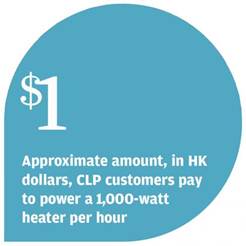
CLP’s average charge per kilowatt hour is 98.7 HK cents, which the power firm says remains one of the lowest in the region.
Chong was non-committal on whether the firm would overhaul its tariff structure to encourage people to conserve energy.
She said it had to be done in a fair manner and take into account the costs of providing electricity to its different categories of users.
Last year, the company proposed a change – advocated by environmentalists – that would have made big users pay more but dropped it in the face of opposition from its business customers.
Chong said CLP would have to consult the stakeholders before making changes in response to public expectations and policy requirements.
City University energy specialist Dr William Yu Yuen-ping, said he doubted whether the two options would really help slow down tariff increases.
“There are going to be more infrastructure projects like the cross-border express rail, and this will boost CLP’s capital expenditure and impact on the basic tariff,” he said, in a reference to the two power companies’ arrangement with the government that allows them a return of up to 9.99 per cent on their net fixed assets.
Yu said if the power firm really did raise its charges by 40 per cent in three years, the annual rise would be as much as 12 per cent
Power tariffs generally consist of two parts, the basic tariff that reflects the capital investment on power generation and distribution; and fuel costs that are passed directly to consumers.
Topics:
CLP
Tariff
Business
SCMP
| Howard Winn Jul 11, 2012 |
|
||||
|
CLP is on a mission these days to explain to the business community and the public that rising fuel costs and environmental improvements will result in higher electricity fuel tariffs. The company is still smarting from its brush with the government in December when it wanted to raise tariffs by 9.2 per cent but ended up with a 4.9 per cent increase after a messy government-inspired public spat. Speaking at a British Chamber of Commerce lunch yesterday, CLP managing director Richard Lancaster reiterated the message, albeit in more restrained tones than his chairman Michael Kadoorie did at the company’s AGM in February. Lancaster pointed out that to meet the government emission caps in 2015, CLP would need to double its use of natural gas and reduce the amount of coal it uses, even though coal is a cheaper fuel. However, the relatively cheap supply of natural gas the CLP has used from the Yacheng gas field south of Hainan Island is due to expire in the next two years. This, incidentally, is brought to Hong Kong by the world’s second-longest subsea gas pipeline that is nearly 800 kilometres long. The government shoehorned CLP into a gas deal with PetroChina (SEHK: 0857, announcements, news)that will supply Hong Kong and other parts of China with gas from Tajikistan via a 9,000 kilometre pipeline that is due to link up with CLP’s Black Point Power Station at the end of this year. CLP concedes the deal is a good one for them, with the gas priced at more or less market prices, with a bit extra added for the pipeline distribution. “We have looked and we cannot find a better deal,” Lancaster said. But he said that when the new gas source came on stream, CLP’s gas bill would increase fivefold after factoring in additional prices and the increased volume required. “The floodgates are opening – we cannot continue to manage our tariffs at this level. If we were to swallow that cost, CLP would go out of business very quickly – in a matter of a few years,” Lancaster said. He added that CLP had used up the various funds – the tariff stabilisation fund and the fuel clause – which it uses to stabilise tariffs. What he didn’t say was that Donald Tsang’s government was unwilling to explain to the public that higher electricity tariffs were necessary to pay for the fuel to meet the government-set emission targets. He pointed out that Singapore, which uses 80 per cent natural gas to provide electricity, has seen electricity tariffs increase 68 per cent over the past seven years and will rise another 4 per cent this year, while Sydney’s tariffs have more than doubled over the same period. Looking further ahead, the government is supposed to set tighter emission caps for 2020, which can only be achieved by increasing the supply of electricity from nuclear power stations. But those consultations have been put on hold since the meltdown in Fukushima. HITting the switch on solar We see that Hongkong International Terminals (HIT) switched on its swish new solar power installation yesterday. The company has installed 129 solar photovoltaic panels above the Terminal 4 gatehouse, making it the fifth-largest solar PV system installation in Hong Kong from the private sector. The panels will produce approximately 19,200 kWh of electricity a year, or enough to power a four-member household in Hong Kong for around three years. The solar PV panels will be used to power the canopy floodlights, gatehouse office lighting and security office equipment. Unlike previous solar installations at HIT, these panels are directly wired into the CLP grid to generate power rather than generate heat, allowing the lights and equipment to automatically switch back to CLP power (SEHK: 0002) if there is not enough solar power to sustain their operations. This leads us to the thought that it is just as well HIT is a customer of Kadoorie’s CLP. If it was a customer of Hongkong Electric (SEHK: 0006), HIT probably wouldn’t be so willing to divert cash out of Li Ka-shing’spocket. |
|||||
SCMP
| Howard Winn Jun 14, 2012 |
|
||||
|
We hear that following the row over higher electricity tariffs earlier this year, CLP has put more or less on “permanent hold” the work on converting its Castle Peak ‘A’ power plant from coal-fired to the cleaner gas-fired boilers. It will now continue to run on coal with just one experimental agglomerator, which removes particle matter, but no scrubbers, which take out sulphur. The government is pressing the power companies to meet emission standards but it would appear that it only wants them to “meet” these standards rather than to better them by a wide margin. That is, the Environment Bureau doesn’t want them to improve their emissions too much, because the resulting capital expenditure would result in a rise in tariffs. The scheme of control, which is negotiated with the government, allows companies an agreed rate of return from its depreciated net assets. At the same time, the government urges the power companies to reduce emissions, but it doesn’t have the guts to tell the public that this will cost more. Instead, it publicly blames the power companies when they try to raise tariffs. CLP had wanted to raise tariffs by 9.2 per cent but after the government-inspired row, ended up with a 4.9 per cent increase. The direct effect of this is lower air quality in an arrangement agreed by the bureau. At the same time, CLP has been forced by the Hong Kong government to buy its gas from the mainland at prices that will have to be negotiated with supplier CNOOC (SEHK: 0883). But since CLP has been cut off from global markets, it’s not hard to see who will have the advantage in those discussions. The Environment Bureau, led by Edward Yau Tang-wah, plays a highly duplicitous role in the politics of Hong Kong air quality. On the one hand it claims that it can’t do much about Hong Kong’s dirty air and says much of the pollution comes from the Pearl River Delta; on the other it ignores effective measures that could be taken to get old buses and trucks off the road. When CLP wants to convert to environmentally cleaner gas, the government and the bureau show they have no stomach for a fight with the public and agree to lower standards |
|||||
From: vyora_yau@enb.gov.hk [mailto:vyora_yau@enb.gov.hk]
Sent: 12 June, 2012 18:10
To: dynamco@netvigator.com; James Middleton
Cc: cwwong@epd.gov.hk; enquiry@epd.gov.hk
Subject: Fw: E(12/1437) CLP conversion works on hold
Importance: High
Dear Mr Middleton,
We note that today you have forwarded your enquiry on 21 April to us again. Perhaps for some reasons our reply to you on 11 May did not reach you, so I am forwarding the reply below to you again. Kindly let me know when you have received this mail, thanks.
Regards,
Vyora YAU, PAS(FM)
—– Forwarded by Vyora SM YAU/ENB/HKSARG on 12/06/2012 17:54 —–
| Vyora SM YAU/ENB/HKSARG PAS[FM] 11/05/2012 12:42 |
|
Dear Mr Middleton,
Many thanks for your e-mail expressing your concerns on the conversion works of CLP’s power plants.
As you may be aware, CLP has two coal-fired power plants in Hong Kong, namely Castle Peak “A” (CPA) and Castle Peak “B” (CPB) plants.
In the past few years, CLP has spent around $9 billion in retrofitting its four CPB power plants. The project includes installation of three types of emission control equipment, namely the Boosted Over Fire Air (BOFA), Selected Catalyst Reactor (SCR) systems and the Flue Gas Desulphurization (FGD) facilities. The installation has reduced the emissions of CPB units by 99.76% for respirable suspended particulates, and over 90% and 50% for sulphur dioxides and nitrogen oxides respectively.
CPA coal-fired power plants are used with a lower priority after the gas-fired plants and the CPB coal-fired plants with retrofits. The conversion works which CLP is now putting on hold are related to the provision of additional generating capacity at the CPA site. In view of the lower than anticipated maximum power demand in 2011, we have strong reservations about the proposal, and have advised CLP to submit the proposal if necessary with supporting justifications in accordance with the Scheme of Control Agreement for our consideration.
Our energy policy objectives are to ensure safe and reliable energy supplies at reasonable prices whilst minimising the environmental impact caused by the production and use of energy. Starting from 1997, power companies in Hong Kong have not been allowed, for environment reasons, to build new coal-fired power plants. To reduce the emissions from the power sector for improving the air quality, we have been imposing emission caps on their emissions, starting from 2005, firstly via their specified process licence and then via a Technical Memorandum (TM) issued under the Air Pollution Control Ordinance. The emission caps have been progressively tightened and the current emission caps for the power sector are about 46%, 76%, 48% of the baseline levels of SO2, NOx and RSP respectively in 1997. In 2010, we promulgated the Second TM to further tighten these emission caps from 2015 onward by 50%, 35% and 34% respectively from the current levels. To meet the new tightened emission caps under the Second TM, the two power companies will have to maximize the use of their existing gas-fired generation units and prioritize the use of their coal-fired generation units equipped with advanced emission abatement facilities to further reduce their emissions. As an on-going process, we will review the TM once every two years.
I trust you would find the information above of help.
Regards,
Ms Vyora YAU
for Permanent Secretary for the Environment
—– Forwarded by Vyora SM YAU/ENB/HKSARG on 11/05/2012 12:21 —–
From: “James Middleton” [dynamco@netvigator.com]
Sent: 04/21/2012 11:54 AM ZE8
To: Anissa SY WONG; Edward TW YAU; <ceeo@ce-elect-office.hk>; <clp_info@clp.com.hk>
Subject: CLP conversion works on hold
The Environment Bureau
Mr Edward Yau Tang Wah
Dear Sir,
We have heard from Clear the Air sources that CLP’s design team who were working on the re-firing work at Castle Peak ‘A’ station has now all been put on semi-permanent hold. and that apparently when the tariff rate rise was hit the first thing that had to get the chop was the conversion of Castle Peak ?
(‘A’ station uses traditional coal fired boilers, which run without FGD, to CCGT Combined Cycle Gas Turbine and gas fired boilers. )
We are informed the existing ‘A’ units will now continue to run on coal but with no environmental measures other than one experimental Indigo agglomerator for four TG sets.
So it seems Government fails again by cutting out the proposed improvements that everyone was looking for ?
Unfortunately, if we want cleaner air it seems we have to make some investment.
We note however that electricity subsides have swung back into force.
We would welcome your comments on this information.
Yours faithfully,
James Middleton
Chairman
www.cleartheair.org.hk
It seems CLP from its recent bitching and threats of increased tariffs does not know where to look to get its gas supply from – maybe someone should tell them ?
http://news.investors.com/article/611667/201205161812/enn-energy-holdings-towngas-setting-up.htm
The combination of China’s voracious energy needs and a global surplus of natural gas makes a compelling story for at least two Hong Kong-listed companies.
Enn Energy Holdings and Towngas, two companies that distribute natural gas in mainland China, are potential leaders in Hong Kong, seen as a gateway for foreigners to do business in the world’s biggest emerging market.
At first glance, it’s hard to get excited about companies that hook up homes and factories to natural gas distribution pipelines.
But many analysts say natural gas has a great future in China. It’s a clean-burning fuel, which is a big plus in a country where the big cities sit under clouds of awful air pollution. Reliance on coal and oil have taken a huge toll on the environment.
Supply also plays well for natural gas. The biggest suppliers for China are found in far more stable countries than those for oil.
The top five natural gas exporters in 2010, says the CIA World Factbook, were Russia, Norway, Qatar, the EU and Canada.
The U.S. stood in seventh place, but may rise as fracking adds to supply at a breakneck pace.
Several new gas-liquefaction plants are under construction in the U.S. and Canada to supply gas abroad, especially to China.
These plants will enable China to tap into the U.S. supply glut, which has pushed prices to $2.622 per million British thermal unit. The latest Asian spot gas price, as reported by energy reporting service Platts, is $17.90 per million Btu.
Towngas China distributes piped gas in mainland China. It also builds gas pipelines and operates municipal gas pipelines.
The stock had been building a tight flat base, but Tuesday’s 3% loss pushed the stock below its 10-week average.
The stock shows a nice 1.4 up-down volume ratio, but a poor D+ Accumulation-Distribution Rating. Remember, the Hang Seng, like the Nasdaq and S&P 500, is in a correction.
The company, which reports twice yearly, showed EPS gains of 40% and 48% in the past two halves. Sales climbed 58% and 36% in those reports.
Enn Energy Holdings also operates in the mainland, running gas pipelines and distributing piped and bottled gas.
Enn Energy improved its EPS 25% and 36% in the past two halves, sales by 49% and 34%.
Enn’s Accumulation-Distribution Rating is a solid B, and its RS line is hitting new highs. Enn has built a 12%-deep flat base with a buy point of 29.40.
The oil & gas transport/pipeline group ranks 14th out of Hong Kong’s 142 industries. It’s been one of that market’s leaders the past four weeks.
SCMP
| Stephen Cheung looks at some of the options to overhaul Hong Kong’s electricity sector and make price changes more transparent for consumers. Each, he says, carries its own risks | |||||
May 15, 2012 |
|
||||
|
Michael Kadoorie, chairman of CLP, announced last week that the utility’s rates could rise by 40 per cent by the end of 2015 due to an estimated 250 per cent hike in fuel costs. This projection is based on higher use of natural gas at prices that are expected to escalate over the next four years. In response, several legislators have recommended open access to power transmission. That would introduce competition among generators, including those on the mainland, and fundamentally restructure Hong Kong’s electricity sector. The sector is governed by a scheme of control, an agreement signed by the Hong Kong government, CLP and Hong Kong Electric (SEHK: 0006) in 2008. Set to expire in 2018, it allows the power companies to earn 9.9 per cent on net assets and 11 per cent on net renewable energy assets, as well as fully recover fuel costs via periodic rate adjustments. In this context, how can we change Hong Kong’s electricity future? In addition to restructuring, we can make fuel cost-driven rate increases more transparent, or invest public funds in generation units and strengthen price regulations. To select the best option, we need to consider the following questions:
As it invites wide participation, the process can become litigious, time-consuming and unmanageable. But, without it, how can consumers be confident that rate rises are based solely on CLP’s cost increases? Moreover, if CLP has bought fuel and managed costs efficiently, it should welcome this transparent process.
Restructuring could work under the right conditions: notably, where there is surplus capacity, many suppliers, easy entry and price-responsive demand. Integration of the electricity markets in Hong Kong and southern China could potentially lead to lower prices. Without such conditions, however, restructuring has traditionally not succeeded in cutting prices or improving reliability. Thus, with its potentially large risks, restructuring may not be the most suitable path for Hong Kong.
Yet many unanswered questions remain. Would the fund be financed through the budget surplus, the reserves or long-term bonds? What if CLP stopped paying dividends? Would the fund set a bad precedent for government intervention? And, if an electricity fund is so desirable, why not a real estate fund?
There are a number of obstacles, however. First, CLP and Hongkong Electric could assert their property rights and refuse to sell at any price. Second, even if they were amenable to selling, they could demand a very high price. Third, the government could be unable to operate the electricity facilities safely and reliably. Finally, the purchase might be seen as anti-business, discouraging investment in Hong Kong – one of the most competitive and business-friendly cities in the world. Each of these choices has its own implementation challenges and cost-risk trade-offs. Establishing a public hearing process, possibly administered by a regulatory commission, is easier and less risky than the other choices. In any case, the question of how Hong Kong’s electricity sector should evolve over the next few years is a critical issue that deserves collective scrutiny. Professor Stephen Y. L. Cheung is dean of the School of Business and professor (chair) of finance at Hong Kong Baptist University |
|||||
| SCMP
Power firm wants government to admit to public that rise in energy bills is down to its requirement that generators cut their carbon emissions |
|||||
| Denise Tsang May 15, 2012 |
|
||||
|
CLP’s group chief executive, Andrew Brandler, has called on the incoming administration of Leung Chun-ying to be more transparent over energy policy than its predecessor has been. Brandler’s comments come as the 80 per cent of the city’s population who depend on CLP for electricity brace for a sharp rise in their energy bills starting from next year. The expected rate increase stems from a deal CLP has struck through Capco, a joint venture of its subsidiary CLP Power (SEHK: 0002), with the National Development and Reform Commission and the state-owned fuel suppliers PetroChina (SEHK: 0857, announcements,news) and CNOOC (SEHK: 0883). Brandler disclosed in an exclusive interview with the South China Morning Post (SEHK:0583, announcements, news) yesterday that the terms of the gas supply contract were agreed six months ago. But he said Chief Executive Donald Tsang Yam-kuen’s administration had yet to approve the deal. The slowness of the approval process angered CLP’s chairman, Michael Kadoorie, who attacked the government last week for its inefficiency but did not then disclose the delay in approving the contract. It was Tsang who agreed to the contract with Beijing in 2008. The new contract provides for the purchase of clean fuel in the form of gas to generate electricity over the next 20 years from 2013. PetroChina will import gas from Turkmenistan to the mainland and funnel it through a submarine pipeline to the Black Point power station. The new contract price, about three times more expensive than the existing gas contract price set 20 years ago, will lift fuel costs by 40 per cent. The existing contract, which expires soon as a result of the depletion of the gas reserve in theYacheng field off Hainan Island, charges US$6 per unit, according to a source. That is roughly one third of what other places, such as Japan, pay. “It is a reasonable price linked to [current] market levels,” Brandler said. “People are angry at CLP and said it’s ripping off customers, but we are not going to make any profit out of it.” Regulations say the city’s two power producers, CLP and Hongkong Electric (SEHK: 0006), must pass fuel costs on to their customers. Brandler blamed the Hong Kong government for failing to explain to the public the consequences of its energy policy, which requires CLP and Hongkong Electric to lower carbon emissions by up to 64 per cent by 2015 from 2010 levels. That means CLP needs to double its gas consumption. “We want more transparency from the new administration,” Brandler said. “The government needs to explain to people about the impact of the energy policy on tariffs.” The Environment Bureau said CLP had been involved in commercial negotiations with its mainland counterparts on the provision of natural gas. It said the bureau would monitor the developments to ensure the arrangements would be in line with its energy policy objectives. CLP raised tariffs by 4.9 per cent in January instead of an originally proposed 9.2 per cent, after pressure from the government and the public. |
|||||
Electricity Prices / Call for public bodies to lower CEOs’ wages
On Backchat we’ll be talking about electricity prices, as CLP warns of soaring prices in a few year’s time. Is it too cheap in HK and should the government be giving more subsidy? How can the next administration safeguard people’s livelihood? After 9.15, a discussion on the fat cats and their pay. (8.30am-9.30am, facebook and backchat@rthk.hk)
8:30 – 9:15 Electricity Prices
Prentice Koo, Campaigner, Greenpeace
Richard Tsoi, Spokesman, Coalition to Monitor Transport and Utilities
Dr. Ronnie Hui, Member, Energy Advisory Committee
| Academic says rising gas prices leave consumers just two choices – use less power, or pay much more | |||||
| Cheung Chi-fai and Denise Tsang May 10, 2012 |
|
||||
|
As gas prices rise and utilities strive to cut emissions, consumers must save energy or see their power bills rise by more than half by 2015, an energy specialist has warned. Professor Tso Che-wah said higher natural-gas prices and greater use of gas to generate cleaner power were inevitable, and the best thing consumers could do to reduce the impact as the costs were passed on to them was to use less. “The most effective way for us, as consumers who wish to have clean electricity without paying significantly more, is to opt for behavioural change, such as reducing consumption,” he said. Tso, an adjunct professor at the School of Energy and Environment at City University, retired from Hongkong Electric (SEHK: 0006) in 2009. His comments came a day after CLP Power (SEHK: 0002) sparked outrage by saying it might have to raise tariffs by 40 per cent in four years to meet rising gas prices. Tso said this was no surprise – his estimates indicated the increase could in fact be as much as 60 per cent in three years. This took into account extra investments to be made by CLP to meet the 2015 emission caps imposed by the government, as well as rising international gas prices. Tso also estimated that the power firm would have to make an investment of HK$6 billion to retrofit two new gas-fired generation units, and perhaps another HK$6 billion for an offshore wind farm, as CLP made gas the basis of half of its total capacity and adopted zero-emission means of generation. He said this meant CLP users would eventually pay HK$1.60 per kW, compared to 98 cents now. Even then, the price would be lower than in many developed nations. On Tuesday, CLP warned of substantial future tariff increases as a result of it having to use much more expensive natural gas from Central Asia, piped through the mainland. This warning spurred demands for more measures to curb tariffs, such as a liberalisation of the energy market. But Tso said the gas price, four times that set out in a procurement contract 20 years ago for a Hainan gas field that is now running out, was beyond the control of the power firm. While some politicians have vowed to press for the allowable rate of return on investment for CLP and Hongkong Electric to be lowered, Tso said this would have no impact on fuel costs, which would be passed on to consumers anyway. Under a 10-year agreement known as the scheme of control, which was signed in 2008 and ties profits to spending on assets, the maximum return for power utilities was set at 9.99 per cent. Tso said the tariff structure could be adjusted to allow for cheaper power at night. Another practical approach would be to step up the interconnection between CLP Power, which serves the New Territories, and Hongkong Electric, which serves Hong Kong and Lamma Island, to minimise the amount of power overproduced for reserve capacity. “There is no technical difficulty in introducing this. All we lack is the political will to do it,” Tso said. Other energy analysts were less pessimistic than Tso about the likely tariff increases. Pierre Lau of Citigroup thought CLP’s price would rise by about 26 per cent, an average of 8.66 per cent a year, between next year and 2015. This would pass on fuel cost rises and earn the maximum 9.99 per cent return for the power firm. Hongkong Electric was expected to lift tariffs less over the three years – by 19 per cent, or 6.33 per cent a year. Amid resistance to bigger electricity bills, CLP lifted its tariff by 4.9 per cent on January 1, after stepping back from its original proposal of 9.2 per cent. Hongkong Electric raised its rates by 6.3 per cent, after first proposing an almost 8 per cent increase. Federation of Hong Kong Industries deputy chairman Stanley Lau Chin-ho said many Hong Kong companies were shocked by the tariff increases CLP predicted. He said bigger power bills would add to companies’ cost burden. “The administration under the new chief executive [Leung Chun-ying] must sort out a long-term solution to keep tariffs stable,” he said. |
|||||